Mirror Symmetry: How to Style Two Mirrors Together
Placement, Proportion, and Light
Symmetry works in a room the same way it works in architecture: it gives the eye a fixed point of reference and lets everything else organize around it. A matched pair of mirrors is one of the most direct ways to build that reference point into a wall.
Two identical mirrors, hung at the same height and spaced evenly around a central point, whether that's a window, a console, or a piece of furniture, create balance that a single mirror can't produce on its own, no matter how large or well-placed. The effect isn't just decorative; it's also structural, setting the proportions for everything else on that wall, from sconces to artwork to the furniture below.
How Symmetry Benefits a Space
Symmetry is a balance of visual weight. When two objects of equal size, shape, and finish sit on either side of a central point, the eye doesn't have to work to reconcile the wall, it reads as resolved immediately, rather than requiring the room to correct for an imbalance elsewhere. This is why symmetrical layouts are used to anchor a room's hierarchy: the eye locates the symmetrical element first, then reads everything else in relation to it.
Mirrors are one of the few objects that do this while also manipulating the room's actual light and perceived scale, which is why a matched pair often does more compositional work than any other single design decision on a wall.
Creating Mirror Symmetry in Different Rooms
That principle plays out differently depending on the room. In an entryway, a room usually defined by its narrowness, dual mirrors placed on either side of a console widen the sightline the moment someone walks in.
Each mirror reflects the opposite side of the room, which reads as more square footage than the room actually has. In a bathroom, symmetry does double duty.
A pair of mirrors above a double vanity aligns with the sinks below it, so the wall reads as one composition instead of two separate stations, and each mirror captures its own source of task lighting rather than sharing one across a wider single mirror.
In a living room, a matched pair flanking a fireplace or a piece of art anchors the wall the way the fireplace itself anchors the room, reinforcing the room's existing focal point instead of competing with it.
In a bedroom, mirrors positioned above matching nightstands extend the symmetry already built into the furniture layout, which is part of why the arrangement reads as resolved rather than busy.
Does the Mirror Style Matter?
Any two mirrors can technically be hung as a pair, but the effect is proportional to how closely they match. Same shape, same finish, same scale, that repetition is what reads as intentional rather than coincidental.
HW Interiors placed a pair of oval burnished brass mirrors above a double vanity, each one aligned directly under its own pendant light so the fixture and mirror shape echoed each other, doubling the task lighting on the wall while keeping the brass warmth consistent across both sides.
Como Arch Mirror from the Heirloom Reflection Collection by Lindye Galloway for Mirror Home
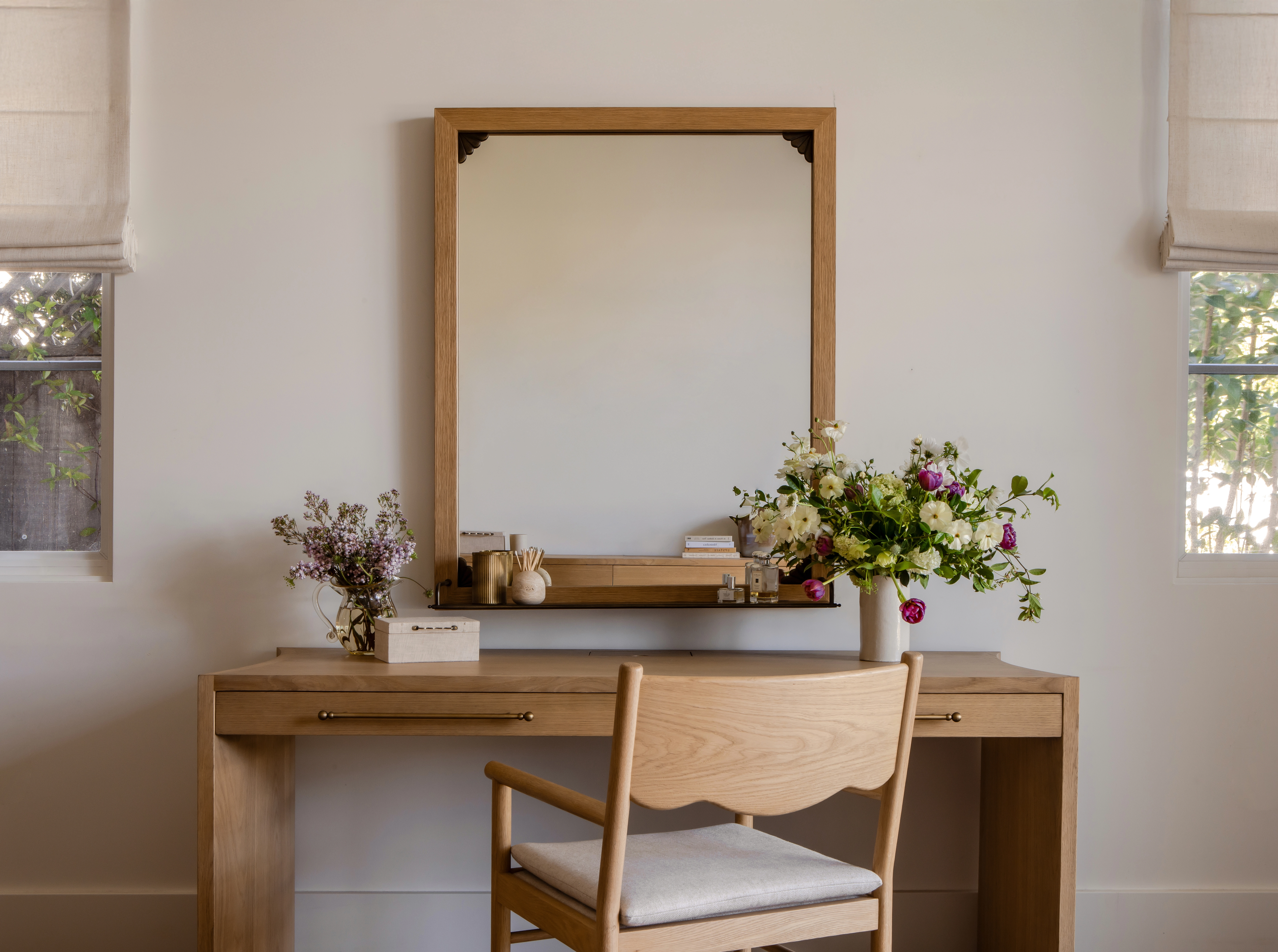
The same principle carried into an entryway project featuring the Como Arch from our Heirloom Reflection Collection by Lindye Galloway, where two arched mirrors in matching aged brass and white oak were placed side by side above a console, their repeated silhouette giving the wall an architectural line and a sense of height it wouldn't have with a single piece.
Hand welded Polished Stainless Steel Mirrors from the Mirror Home Collection
A primary bathroom by Anne Rue Interiors took a more restrained, yet equally beautiful approach, centering our hand welded polished stainless steel mirrors finished in brushed brass above each sink at matching height to hold a level sightline across a wall that also had to accommodate sconces, tile, and hardware, keeping the eye anchored despite the number of competing elements.

Stainless Steel, Burnished Brass Mirrors from the Mirror Home Collection
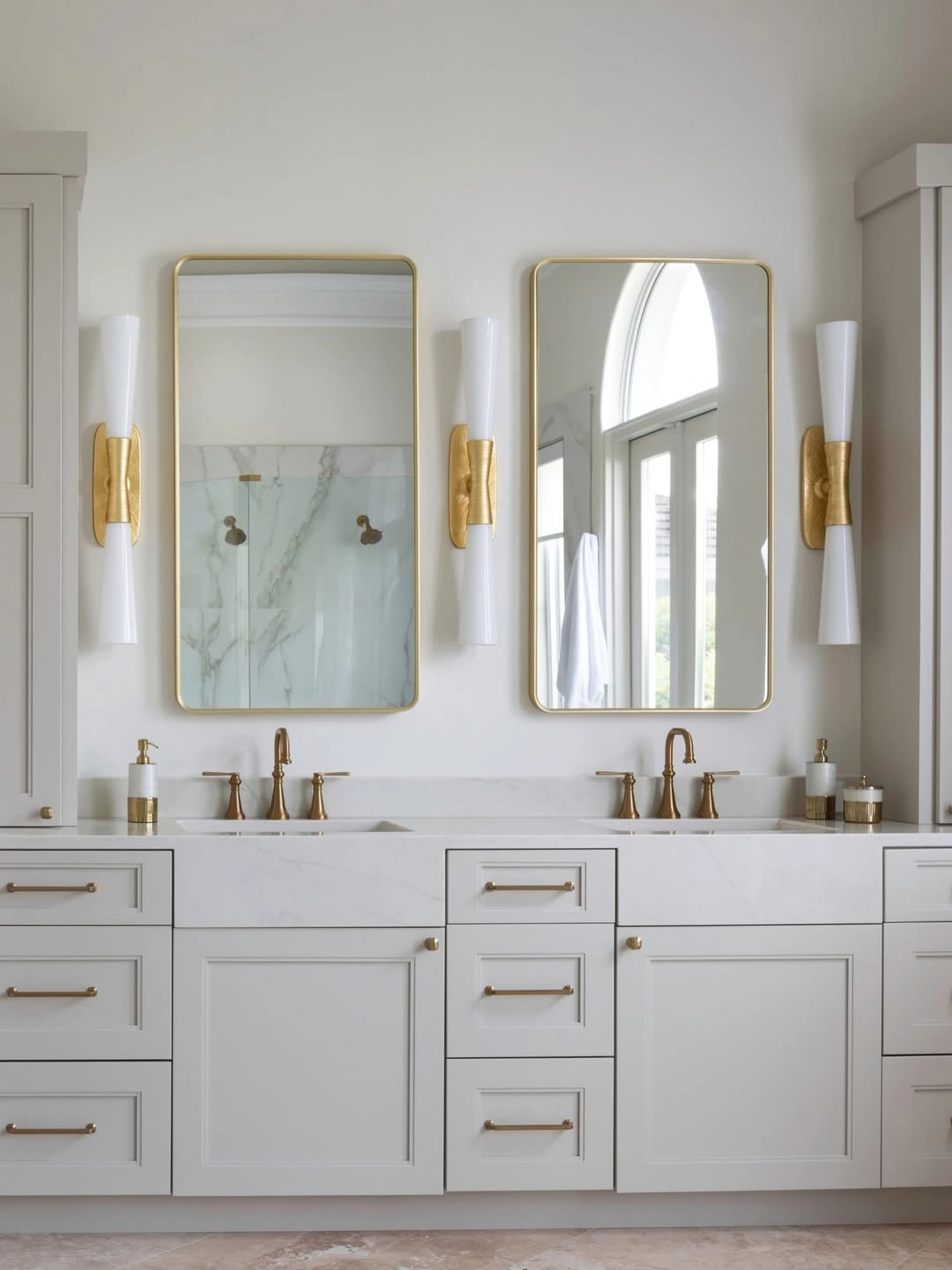
Julie Rootes Interiors chose a pair of our stainless steel, burnished brass mirrors from our Mirror Home Collection for a coastal bathroom specifically to reflect the room's marble and brass without duplicating those materials directly, adding geometric interest and depth to a soft, pared-back palette.

Laurent Mirror from the Barclay ButeraCollection for Mirror Home
A Park City primary suite designed by Barclay Butera, features two of our Laurent mirrors from the Barclay Butera Collection for Mirror Home , mounted above the nightstands flanking the bed picked up the room's exposed wood beams and windows, extending the scale of the vaulted ceiling down to eye level and tying the room's material story into the seating area below it.

How to Style Dual Mirrors: Placement Guidelines
A few specifics separate a pair that works from one that doesn't. Match the mirrors exactly in shape, size, and finish. Even small inconsistencies can create a sense of chaos rather than intentional, considered styling.
Hang both mirrors from the same center point height, not the same top or bottom edge, so the eye reads one continuous horizontal line across the wall. Additionally, keep the spacing between the two mirrors and the object they're flanking equal on both sides, and size the pair in proportion to what's below them, a mirror that's too narrow for the vanity or console it hangs above will break the symmetry it's meant to create.
Avoid hanging two mirrors directly across from each other on opposite walls, since that produces an infinite, distracting reflection rather than a considered one. Instead, angle the pair toward something worth reflecting, a window, a light fixture, or an architectural detail, so the placement does more than fill wall space.
Styling Mirrors in Pairs
A matched pair of mirrors is one of the most reliable ways to bring structure, light, and proportion to a wall, whether that's an entryway console, a double vanity, a fireplace, or a set of nightstands. The effect depends on precision: matching finishes, aligned heights, even spacing, and a clear sense of what each mirror is meant to reflect.
Mirror Home's collection includes finishes and silhouettes suited to exactly this kind of pairing, from the burnished brass and oval shapes used above vanities to the arched, wood-framed pieces built for entryways and living spaces.